More Inspiration for You
* Amazon Affiliate Links



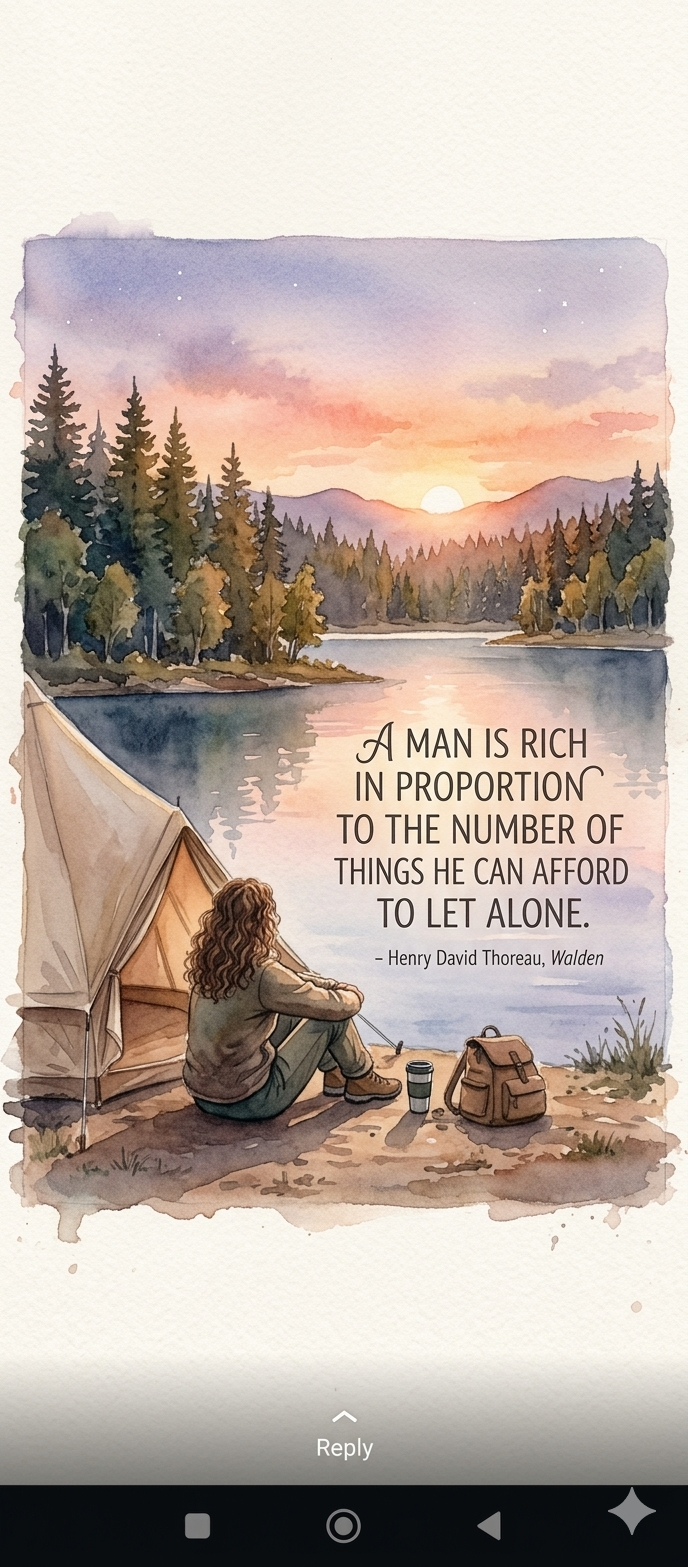
“I went to the woods because I wished to live deliberately.” This sentence, written in 1854, sounds today like an answer to everything that exhausts us in 2025.
You know that feeling. Monday morning that feels no different from Thursday evening. A calendar full of duties, but empty of meaning. The quiet suspicion that the life you’re living isn’t quite the one you mean to live.
Henry David Thoreau felt the same — in 1845. And he did something radical: He stopped thinking about it. He acted.
He built himself a cabin at Walden Pond in Massachusetts, lived there for two years, two months, and two days — and wrote one of the most influential books in world literature. But Thoreau was far more than a hermit with a good writing style. He was a philosopher, naturalist, political thinker, and one of the first modern environmental activists.
Who he really was. What Walden really means. And why his thoughts today — in an age of burnout, climate crisis, and digital noise — are more relevant than ever.
Let’s dive deep.
In this article
- Who Was Henry David Thoreau?
- Walden: Why Did He Go Into the Woods?
- His Philosophy: What Does “Deliberate Living” Mean?
- Civil Disobedience — The Text That Changed the World
- The Most Famous Thoreau Quotes and What They Really Mean
- Thoreau, Gandhi, King: A Line of Resistance
- What Thoreau Would Say to Us Today
- Frequently Asked Questions
Who Was Henry David Thoreau? A Man Who Refused to Function
Henry David Thoreau was born on July 12, 1817, in Concord, Massachusetts — the son of a pencil manufacturer and a spirited mother who opened her home to abolitionists. From the start, he lived in a world where conscience mattered more than the social contract.
He studied at Harvard University, graduated in 1837 — and then did the unthinkable: He rejected the safe career paths of his time. Law. Theology. Medicine. None of it. Instead, he taught briefly, quickly gave up when he was expected to physically punish students, and began to write, observe, think.
He was no ascetic who despised the world. He loved company, enjoyed joking, was an enthusiastic walker. Nor was he a perfect saint — sometimes he visited his mother in Concord during his woods sojourn, letting her cook for him. That’s precisely what makes him human.
What set him apart: He refused to trade time for money when that money wasn’t needed for anything essential. He worked only as much as he had to — and the rest of the time belonged to him.
“You must live in the present, launch yourself on every wave, find your eternity in each moment.”
— Henry David Thoreau, Journal
Thoreau died young — at 44, on May 6, 1862, of tuberculosis. He died peacefully, without regret. Asked if he had made his peace with God, he reportedly replied: “I was not aware we had ever quarreled.”
Walden: Why Did He Really Go Into the Woods?
On July 4, 1845 — American Independence Day, no coincidence — Thoreau moved into a small wooden cabin he had built himself, on the shores of Walden Pond. The land belonged to his mentor and friend Ralph Waldo Emerson.
He was 28 years old.
He stayed 2 years, 2 months, and 2 days.
What did he want there? Not to flee. Not to hide. He wanted to find out. Find out what is truly necessary. What life means when you strip away everything superfluous. Whether you can be happy with little — or whether happiness lies in more.
He planted beans. He read Homer in the original. He watched ants like a scientist. He wrote for hours. He swam in the pond before the world woke up.
His experiment was not an end in itself. It was a question: What does a person truly need?
His answer: food, shelter, clothing, warmth. The rest — we build that in because society demands it. Not because we need it.
The most famous passage from Walden
“I went to the woods because I wished to live deliberately, to front only the essential facts of life, and see if I could not learn what it had to teach, and not, when I came to die, discover that I had not lived.”
The book Walden, published in 1854, was not a bestseller in Thoreau’s lifetime. Only in the 20th century did it become what it is today: one of the most influential books in American literature — and a text that people around the world read when they feel trapped in the wrong life.
Thoreau’s Philosophy: What Does “Deliberate Living” Really Mean?
“Deliberate living” is the heart of Thoreau’s thinking. But what exactly does he mean by it?
It doesn’t mean you have to move into the woods. It means you stop living on autopilot. That you ask yourself: Do I actually want this? Or am I doing it because everyone else is?
Thoreau was a Transcendentalist — a philosophical movement that believed that a person’s highest knowledge comes not from external authorities (church, state, society) but from inner experience, intuition, and encounters with nature.
For Thoreau, this meant concretely:
- Simplify. Not wanting more than you need. “Simplify, simplify, simplify.”
- Self-reliance. Not being dependent on others — economically, mentally, emotionally.
- Connection to nature. Viewing nature not as a resource, but as a teacher.
- Inner compass. Placing one’s own conscience above social norms.
- Presence. Not living for some future happiness, but in the now.
This is not otherworldly romanticism. It is a practical life philosophy that Thoreau lived himself — and that enabled him to be one of the clearest political voices of his time.
“The mass of men lead lives of quiet desperation.”
— Henry David Thoreau, Walden (1854)
This sentence is perhaps the most quoted from Walden — and it cuts even deeper today than in 1854. “The mass of men lead lives of quiet desperation.” Not loud. Not dramatic. Simply quiet. A life in which you function, but don’t live.
Thoreau saw this as the greatest tragedy of his era. We may ask ourselves: Is it ours as well?
Civil Disobedience — The Text That Changed the World
In 1846, during his time at Walden, Thoreau was jailed for one night. His crime: He refused to pay the poll tax — as a protest against slavery and the Mexican-American War.
One night. But it changed his thinking — and through his writing, world history.
In 1849, his essay “Resistance to Civil Government” appeared, later known as Civil Disobedience. The core thesis is as simple as it is radical:
If a law is unjust, it is not only the individual’s right to break it — it is their duty.
Thoreau argued that the individual’s conscience must stand above the law of the state. Not obedience, but moral action is the highest civic duty.
This text became one of the most widely read political essays in world history — and directly inspired:
- Mahatma Gandhi, who applied Thoreau’s ideas to the Indian independence movement and called them “Satyagraha” (truth-force).
- Martin Luther King Jr., who used Civil Disobedience as the philosophical foundation of the American civil rights movement.
- Leo Tolstoy, who conducted an extensive correspondence about Thoreau’s ideas.
- Countless climate activists, peace movements, and human rights defenders to this day.
One man, one night in jail, one essay. Sometimes that changes everything.
The Most Famous Thoreau Quotes — and What They Really Mean
Thoreau’s sentences are short, precise, and hit the mark. Here are his most important thoughts — with what lies behind them:
“Go confidently in the direction of your dreams. Live the life you have imagined.”
What he means: Don’t wait until all circumstances are right. The right moment doesn’t come — you create it by walking into your vision, rather than running ahead of it.
“Men have become the tools of their tools.”
What he means: Tools are meant to serve us — but often the relationship reverses. Today he would write this sentence about smartphones.
“It is not enough to be busy. So are the ants. The question is: what are we busy about?”
What he means: Being busy is not a virtue. What matters is what you sacrifice your time — your lifetime — for.
“As if you could kill time without injuring eternity.”
What he means: Every wasted hour is a wound to the only resource we never get back: our life.
“Simplify, simplify, simplify.”
What he means: Not reduction as punishment, but as liberation. Less possessions, fewer obligations, less noise — more space for what matters.
Thoreau, Gandhi, King: A Line of Peaceful Resistance
Few thinkers have left such a direct line of influence as Thoreau. It is no exaggeration to say that without Civil Disobedience, the world history of the 20th century would have been different.
Mahatma Gandhi read Thoreau’s essay during his time in South Africa and described it as confirmation and inspiration for his nonviolent resistance. “Thoreau’s name will forever be linked with the struggle against oppression,” he wrote.
Martin Luther King Jr. called Civil Disobedience the first intellectual foundation of his belief that moral wrong must be opposed by peaceful but determined refusal. The civil rights movement’s sit-ins — directly from Thoreau’s thinking.
This line extends to today: climate activists blocking streets. Whistleblowers acting against the law because conscience demands it. Peace movements on every continent.
A man who refused to pay his taxes in 1846 changed the world. That is the power of a consistent conscience.
What Thoreau Would Say to Us Today
Imagine Thoreau lived today. What would he see?
He would see that the “quiet desperation” of 1854 wears a new costume: burnout, doom-scrolling, the fear of coming up short in the lives of others. He would see that we have created tools that rule us. He would see that we own more than any generation before us — and still feel like we never have enough.
And he would probably write. Clearly, mercilessly, with humor.
But he would also say the same thing he said in 1854: You don’t have to wait until society changes. You can start now. In small steps. A conscious morning. An hour without a screen. A walk where you truly look.
Thoreau is not a call to flee the world. He is a call to return to yourself.
And that may be the most radical thing anyone can still do today.
Did this article make you think?
Share it with someone who currently feels like they’re not really living.
Frequently Asked Questions About Henry David Thoreau
Why did Henry David Thoreau live alone at Walden?
Thoreau did not go into the woods out of loneliness or escapism, but as a philosophical experiment: He wanted to find out what a person truly needs to live — and whether one can lead a deeper, more meaningful life by stripping away everything superfluous. He described it himself as an attempt to “live deliberately” and confront the essential.
How long did Thoreau live at Walden?
Thoreau lived at Walden Pond from July 4, 1845, to September 6, 1847 — exactly 2 years, 2 months, and 2 days. The book “Walden,” which emerged from this period, was published in 1854.
What is Thoreau’s Civil Disobedience explained simply?
In his essay “Civil Disobedience” (1849), Thoreau argues that a person is obligated not to obey an unjust law. The individual’s conscience stands above state law. He wrote this text after a night in jail, where he ended up because he refused to pay taxes in protest against slavery and a war.
What influence did Thoreau have on Gandhi and Martin Luther King?
Gandhi read Thoreau’s Civil Disobedience during his time in South Africa and called the text a direct inspiration for his nonviolent resistance. Martin Luther King Jr. described Thoreau as one of the most important intellectual influences on the American civil rights movement. Both adopted the idea of peaceful but determined disobedience toward unjust laws.
What is Transcendentalism explained simply?
Transcendentalism was a 19th-century American philosophical movement that believed the deepest knowledge comes not from books or institutions but from a person’s inner experience and their encounter with nature. Key figures include Ralph Waldo Emerson and Henry David Thoreau. The movement emphasized individualism, self-reliance, and the divinity of nature.
What does “live deliberately” mean?
“Live deliberately” means to live consciously or intentionally. Thoreau meant: not living automatically, not being swept along by the current of society, but deciding for yourself what truly matters to you — and then acting according to that decision.
Is Thoreau’s philosophy still relevant today?
More than ever. In an age of digital constant noise, consumer pressure, and collective burnout, Thoreau’s question — “What do I really need?” — is perhaps the most urgent question of all. His call for simplification, connection to nature, and acting according to one’s own conscience has gained significant attention again in recent years.
This article is part of the Reflections series on inktales.org — texts about people, books, and thoughts that accompany a lifetime.
📝 Text Signal from Inktales
Sometimes a new story appears.
Subscribe to receive a short signal when a new post is live.
No schedules. No extra mail. Only when something is new.
Quietly, you’ll be notified when a new thought appears.